skip to main |
skip to sidebar
02:26
Bengal Media

The name of Netaji Subhaschandra Bose will always be remembered by the Indians with great love and respect. He is considered to be one of the greatest patriots of all times.
Subhaschandra was born in Cuttack in the state of Orissa on 23rd January in 1897. His father Janakinath Bose was a lawyer. Subhaschandra was a good student. He was a born leader. His love for his motherland was manifest even when he was a student.
After graduation, Subhaschandra went to England to sit for the I.A.S. examination . He passed the examination but refused to serve the British who were rulling India. He returned to India and joined the freedom movement under the leadership and guidance of Deshabandhu Chittaranjan Das. Very soon he became one of the most popular leaders of the country. The British rulers were afraid of him. they placed him behind bars several times, and tried in many ways to subdue him. The fiery spirit of Subhaschandra won him many followers in the Indian National Congress. Subhaschandra was elected President of the Congress despite opposition from such great leaders as Mahatma Gandhi.
When he left the INC to form his own party, the Forward Bloc, the world was on the brink of a great war. The Second world War broke out in 1939, ans Subhaschandra was interned in his own house in Kolkata. He left India i disguise soon after, and went from Germany to Japan. In Japan he took charge of the Indian National Army- the Azad Hind Fouj- and came to be known as Netaji.
Netaji led the Azad Hind Fouj in a battle with the British forces and succeeded in capturing Kohima, a town in the state of Manipur in India. Unfortunately for Netaji, the war was drawing to a clsoe, and the Japanese were retreating. One day, in 1945, Netaji took off in an aeroplane for an unknown destination. The aeroplane crashed and it was reported that Netaji had been killed in the crash.
Many people do not believe the story of Netaji's death. There is a mystery surrounding the story. Netaji will live forever in the memory of every Indian. The history of India's struggle for freedom will keep on record the great exploits of Netaji Subhaschandra Bose.
00:56
Bengal Media

Rabindranath Tagore, a great Indian poet, is my favourite poet. Rabindranath wrote his poems, songs, short stories and other articles in Bengali. I consider myself very fortunate because I can read and write Bengali and so I can read Rabindranath's works in the original.
Rabindranath Tagore was the first Indian to receive the Nobel Prize. He won it for his wonderful collection of devotional sons-"Geetanjali". It was in 1912 that he was awarded the coveted prize. Rabindranath was born in the illustrious Tagore family of Jorasanko in Kolkata in the year 1861. His date of birth, according to the Bengali calender, was 25th Vaisakha(9th May). Rabindranath's father was Maharishi Devendranath Tagore, a deeply religious man who was a leader of the Brahmo Samaj.
Rabindranath wrote many beautiful poems and songs. He was a gifted musician, and composed the music for most of his songs himself. The songs of Tagore, popularly called "Rabindra Sangeet", are very popular with music lovers. Rabindranath wrote short wherein he depicted the social condition of his time. His short stories are still popular.
Rabindranath established, the Santiniketan near Kolkata, a school wherein he experimented with his own ideas in education. It has now become a university- the Viswa Bharati-acknoledged by people all over the world to be a great seat of learning.
Rabindranath died in 1941, but he is still remembered, loved and respected by all for his poems, songs and short stories. he is the national poet of two nations India and Bangladesh. In India, "Jana Gana Mana", a song composed by him, is the national song. The works of Rabindranath have been translated into many languages. We Indians are very much proud of him.
23:54
Bengal Media

When the figure of literacy is going down and down, when causes of indiscipline and lawlessness are on the increase day after day, when industrial units are closing their doors one after another, the news that Prof. Amartya Sen has won the Nobel Prize in Economics for the year 1998 comes as a shot in the arms of bengal. Every bengali anywhere in the world feels proud on account of his great achievement. Prof. Sen's honour is really a moral-booster for us all, Rabindranath Tagore was the first bengali and the first Indian and the first Asian to win the Nobel prize in Literature in 1913, and Amartya Sen again in 1998 is the first Nobel laureate in Economics.
Amartya Sen was born in November 3, 1933. His father was Ashutosh Sen, an expert in agriculture. His mother, Amita Debi, was a noble lady. He is the grandson of kshiti Mohan Sen, a Sanskrit teacher of Viswabharati. It was Rabindranath who gave him his name. He had his early education at Santiniketan. Then he moved to Presidency College, Kolkata. Finally he became a student of the Cambridge University. He is at present the Master of Trinity College, Cambridge, a rare honour for anyone. He taught in Jadavpur University (1956-58), Delhi University (1963-71), London School of Economics(1971-77), and Oxford University(1977-80). He has also taught at Harvard as a professor of Economics and Philosophy. He is a great teacher and is very popular with his students. He is really a polite and humble gentleman. Unlike other Indians abroad, he has not severed his connection with his motherland. Nor has he ever applied for any foreign citizenship. Every year he visits Santiniketan during the winter. At that time he does not feel ashamed to put on a dhoti or to ride an old bicycle or to gossip at an ordinary tea-shop.
He has already written eighteen books and earned international recognition as an author. Among his notable books we may mention, Choice of Techniques(1960), Growth Economics(1970), On Economic Inequality(1973), Poverty and famines(1981), Choice, Welfare and Measurement(1982), On Ethics and Economics(1987), The Political Economy of Hunger(1990-91), Economic Development and social Opportunity(1995).
He is joyous because the Nobel Committee has particularly recognised and mentioned his contributions in Welfare Economics which he loves so much. He is not ready to recognise the economic development of India which is the fourth state in the world to go nuclear because its performance in health, education, land-reforms and certain basic requirements is extremely unsatisfactory. Now it to be seen how the indian Govt. makes the best use of his wonderful feats in the field of Welfare Economics. We wish Amartya Sen a long, prosperous, happy and healthy life.
23:14
Bengal Media
Sir Jagadish Chandra Bose was born in a bengali family in the year 1858 in Mymensingh, now in Bangladesh.Having received his primary education in the village Pathsala he came to Kolkata and took admission in St.Xavier's School. He completed his graduation from St.Xavier's College. Then he went to England and took his B.Sc degree from Cambridge University.
On his return to India, he joined Presidency College, Kolkata, as a professor. During his service career he carried on extensive research on Electro-magnet and plant-life during the period 1884 to 1915. His great post retirement work, foundation of the Bose Institute in Kolkata in 1917, enormously helped development of Science in India. As a scientist Sir J.C.bose is ranked as one of the greatest in the world. This great scientist left us in 1937.
22:47
Bengal Media

Raja Rammohan Roy was a great social reformer of India. He was born on May 22, 1772 in a Bengali Brahmin family in West Bengal. As a student, he learnt many languages like Bengali, Urdu, Sanskrit, English, Arabic, Latin, French, Persian etc. He was given the title Raja by the Mughal emperor for winning a case for him.
Rammohan Roy was a great scholar who studied the Holy Quran and the Upanishads. He joined the Ease India Company from 1805 to 1815 for ten years. After retiring, he spent the rest of his life serving the people of India.
Raja Rammohan Roy had always been interested in social reforms. He worked very hard for improving the conditions of the people of India, and did great work in social, religious, political and educational fields.
Raja Rammohan Roy is best remembered for his work against the Sati System. It was a cruel practice where a wife had to burn herself at the funeral pyre of her husband. He persuaded the people of Bengal to rise against it. Finally, Lord William Bentinck declared Sati to be illegal in 1829.
He founded the Brahmo Samaj which was against idol worship. He fought for the rights of women. He wanted to free Hinduism of all its evils and make it a noble religion again. He fell ill in 1833, and died on September 27. His service to the cause of women will always be remembered.
22:34
Bengal Media

Saurav Ganguly, bengali's pride was born on 8th July in 1972. He was born in a renowned family. His father Mr. Chandi Ganguly is an affluent printer.
Ganguly's first step towards cricket was a happy accident of fate: Ganguly was not encouraged to play cricket because his parents wanted him to focus on his studies as he was a very sharp and intellingent student but his elder brother Snehasish was an accomplished cricketer. Sourav started to follow his brother and started playing cricket.
As a person Sourav Ganguly is very quiet, reserved, undemonstrative man with nerves of steel. Sourav is a deeply religious person and observes a fast every Tuesday.
He is married to Dona, who is a famous odissi dancer.
Achievements
In February 2008, Ganguly joined as the captain of Kolkata Knight Riders (KKR) team, owned by Bollywood actor Shahrukh Khan, as part of the Indian Premier League (IPL)
Ganguly was appointed the Captain of the Indian cricket team in February, 2000.
Ganguly was the Man of the Series in the New Zealand-India 5 match ODI series in November 1999.
Ganguly made a mammoth 183 against Sri Lanka in World Cup 1999, which, at that time, was the Highest ODI Score by an Indian, beating Kapil Dev's Record of 175*.
Ganguly was the Man of the Series in the Pepsi Cup 1999 (March-April) for scoring 278 runs and taking 6 wickets in total.
Saurav Ganguly has the distinction of being one of the few players in the World to Score a century and take 4 wickets in the same match. (ODIs)
Saurav Ganguly along with Tendulkar forms the 4th Best Opening Pair in the History of One-day cricket.
Saurav Ganguly and Tendulkar were involved in a World Record Opening Partnership of 252.
Saurav Ganguly scored a Century on Debut at Lords in 1996, and went on to score a century in the very next match as well.
Saurav Ganguly was named Sport star Person of the Year 1998. He also won the Arjuna Award in 1998.
Saurav Ganguly was the Highest Run-Scorer for India in ODIs in 1997.
In the Sahara Cup 1997, Saurav Ganguly set a new World Record for 5 consecutive Man of the Match Awards. He was also the Man of the Series.
01:59
Bengal Media

Bankimchandra Chattopadhyay was the father of the modern Bengali novel. During the days when the Bengali literature was in its infancy, Bankimchandra's powerful pen produced wonderfully romantic novels.
Various are the themes on which Bankimchandra based his novels. They are historical, social, political and romantic. Bankimchandra wrote satirical essays. The essays are proofs of Bankimchandra's great erudition and his awareness of the social and political evils of the time. They are full of humour and are fondly read by the bengalee readers.
Almost a century has passed since Bankimchandra's death. The Bengali literature is not enriched by the contributors of such great writers as Rabindranath Tagore, Sarat Chandra Chattopadhyay, Kazi Nazrul Islam and Michael Madhusudan Dutta. And yet, the works of Bankimchandra are acknowledged by all to be treasures that the Bengali literature can be proud of.
Bankim Chandra wrote his novels at a time when the people of India had only begun to organize themselves and intensify their struggle for freedom from the British rulers. To the freedom fighters the writings of Bankimchandra were sourcesog great inspiration. "Anand Math", one of the most popular novels written by him, reveals the love that he has for his country. "Bande Matram", a song written by him, is now our national song.
"Raj Singha" is based on history. "Vish Vriksha", "Rajani" and "Krishkanter Will" have social themes. "Kapalkundala" and "Devi Chaudhurani" also depict social evils that tormented people in those days, but they are full of romance and adventure.
In "Kamalakanter Daptar" Bankimchandra reveals his keen perception of social evils and political shortcomings. His essays have established him as a powerful critic and his satirical style of writing is inimitable.
16:27
Bengal Media
Swami Vivekananda was born as Narendranath Dutt on January 9, 1862 in Calcutta. He was a very intelligent child and devoted to spirituality from the very childhood. The piousness of his parents had a great impact on his spiritual life.
Naren had deep spiritual experiences from a very early age. He used to forget the mundane life while meditating. He was a born leader. He first met Shri Ramakrishna, the renowned spiritual leader in 1881. That meeting had a deep impact on his philosophical life and Shri Ramakrishna accepted Naren as his disciple. Henceforth, we see Swami Vivekananda as a changed man.

At his first meeting, Naren asked the famous saint if he had seen God. When Shri Ramakrishna replied "Yes", Naren immediately accepted him as his Guru.Thus began the everlasting relationship between the two. Narendranath's immense desire to attain the height of spiritualism was nurtured under his Guru's guidance. Ramakrishna chose Naren as his heir. After his spiritual abode, Naren came to be known as "Swami Vivekananda".
He travelled all over India spreading his Guru's message of experiencing God within oneself and to get united with him. He was a devout patriot and a great orator. His profound thoughts mesmerized the entire world. Wherever he went, he was received with love and respect. This was apparent when, he represented India in the Parliament of Religions in 1893 in Chicago and influenced the entire world with his eloquent speech. He had many admirers of whom, Sister Nivedita (Margaret Elizabeth Noble), a Scots-Irish social worker and teacher was the most notable. Back in India, he established the Ramakrishna Mission Association, which carries forward his work even today. This great saint of India passed away on July 4, 1902, leaving behind an enlightened vision, which everyone should strive to achieve in his life.
13:28
Bengal Media
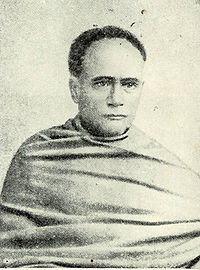
Pandit Ishwar Chandra Vidyasagar was born in a village called Birsingha, in the district of Midnapore. Thakurdas Bandyopadhyay was his father and his mother was Bhagabati Devi. They were very poor. But Ishwar Chandra was very intelligent. His intelligence was marked by his indomitable quest for knowledge. He used to study under the street light as it was not possible for him to afford a gas lamp at his own home. He passed all the examinations with excellence and in quick succession. He was rewarded with a number of scholarships for his academic performance. He came to Calcutta (Kolkata) with his father and got admitted to the Sanskrit College and later on he became the Principal of that college.
He was not only a learned man. He had a heart that bled to see the suffering humanity. He opened many schools to spread education. He wrote many text books.
His famous books are :
BARNAPARICHAY (PARTS I & II, 1855)
RIJUPATH (PARTS I,II & III, 1851-52)
SANSKRITA BYAKARANER UPAKRAMANIKA (1951)
BYAKARAN KAUMUDI (1853)
Vidyasagar reconstructed the Bengali alphabet and reformed Bengali typography into an alphabet (actually abugida) of twelve vowels and consonants. Vidyasagar contributed significantly towards the Bengali and Sanskrit literature.
He worked hard for female education and widow marriage. We remember him as a great teacher and social reformer who fought all his life for the moral uplift of the society. It is said that Vidyasagar was the founder of the modern society. This self-less, kindhearted great man wanted to see India free from the curses of ignorance. Shortly after Vidyasagar's death, Rabindranath Tagore reverently wrote about him, "One wonders how God, in the process of producing forty million Bengalis, produced a man!"


